

American Greatness
By Stu Cvrk
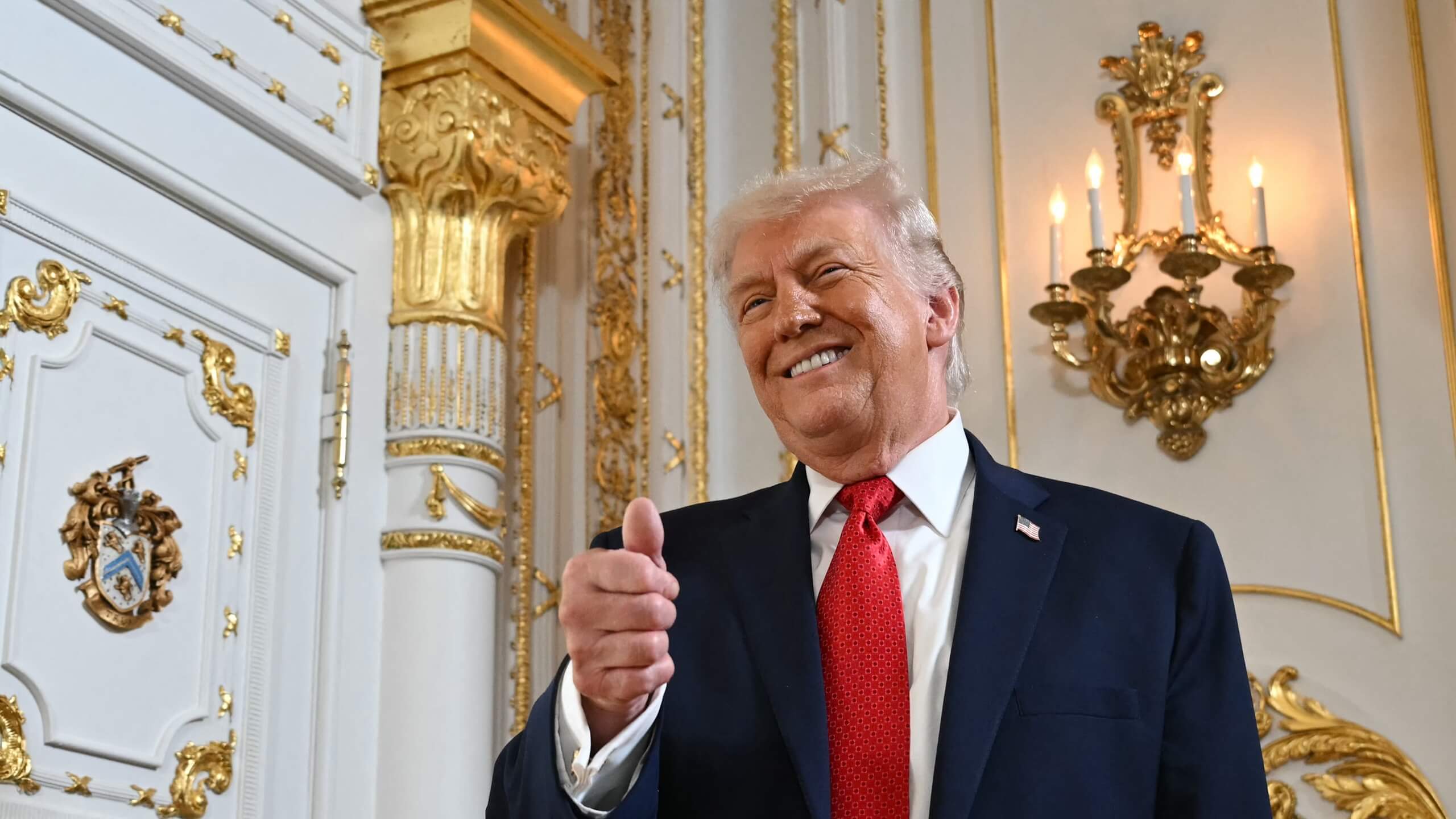 Photo: US President Donald Trump gives a thumbs up as he arrives at a dedication ceremony for Southern Boulevard, in the ballroom at Mar-a-Lago in Palm Beach, Florida, on January 16, 2026. (Photo by ANDREW CABALLERO-REYNOLDS / AFP)
Changing America and the world while restoring Article II of the U.S. Constitution.
Last November, an article was posted that summarized Trump Administration Accomplishments in 2025 through October. At that time, President Trump had just signed the One Big Beautiful Bill into law, brokered a string of ceasefires, and was nine months into what was shaping up to be one of the most consequential presidencies in American history.
Since then, the pace has, if anything, accelerated, with a full-scale operation resulting in the capture of a hemispheric narco-dictator, the implementation of the largest tax cut package in a generation, a childhood vaccine schedule overhaul, a new NATO spending baseline, and a genuinely dangerous stretch of open war with Iran over the Strait of Hormuz that is still not fully resolved as of this writing.
Let us pick up where that article left off and summarize Trump administration accomplishments since then.
DOMESTIC POLICY: IMPLEMENTING THE ONE BIG BEAUTIFUL BILL
The signature domestic accomplishment of the fall and winter was not a new law, but the rollout of the law already signed—H.R. 1, the One Big Beautiful Bill Act (OBBBA), which Trump signed on July 4, 2025. Most of its individual-side provisions took effect January 1, 2026, and by the bill’s one-year anniversary the effects were measurable. The law permanently locked in the 2017 Tax Cuts and Jobs Act rates and the doubled standard deduction, which—absent the OBBBA—would have expired at the end of 2025 and triggered a tax increase on most households. The Tax Foundation estimated the average American taxpayer would see a federal tax cut of roughly $3,752 in 2026, with every state benefiting to some degree.
The bill also delivered on specific 2024 campaign promises: no tax on tips (roughly 7 million workers claimed the deduction) and no tax on overtime (28 million claimants), an increased SALT deduction cap, a $6,000 senior deduction, and reform of Medicaid and SNAP. The Bipartisan Policy Center and Tax Foundation both note that OBBBA is the sixth-largest tax cut in U.S. history by the standard scoring conventions, projected to reduce federal revenue by roughly $5 trillion from 2025 to 2034—though tariff revenue and stronger wage/income tax receipts have kept FY2026 federal revenue running about 5 percent ahead of FY2025 even with the cuts in place.
Most relevant to the youngest Americans, the OBBBA created Trump Accounts, a new tax-advantaged savings vehicle that functions as a special traditional IRA for children, with the federal government seeding $1,000 into the account of every eligible U.S. citizen born from 2025 through 2028. Parents and family members can contribute additional funds that grow tax-deferred for the child’s future education, first home, or retirement. It is the first federal policy of its kind—a direct, ownership-society answer to the entitlement-state model, giving every American child a stake in the country’s capital markets from birth. This program will play a major part in countering the creeping cultural rot (the public education system, Hollywood, academia, legacy media) that has persuaded many younger Americans that “socialism is the answer” to life’s challenges.
GOVERNMENT EFFICIENCY (DOGE) AND DEREGULATION
The Department of Government Efficiency continued its work despite the litigation and congressional friction noted in that earlier article, with claimed savings pushing toward the quarter-trillion-dollar mark and continued federal workforce attrition through hiring freezes, return-to-office mandates, and automation of processes like federal retirement filing. A rescissions package and impoundment actions targeted programs the administration deemed wasteful, while fraud investigations expanded into state-level abuse of federal benefit programs, including a high-profile Minnesota probe.
The deregulatory push continued at pace, with the administration’s cumulative regulatory-cut ratio remaining a signature talking point, concentrated in energy, environmental, and labor rulemaking.
MAKE AMERICA HEALTHY AGAIN: FOOD, VACCINES, AND CHRONIC DISEASE
HHS Secretary Robert F. Kennedy Jr.’s MAHA Commission moved from its September 2025 strategy document (120-plus initiatives) into implementation. The FDA continued working with industry toward eliminating petroleum-based synthetic dyes like Red 40 and Yellow 5 from the food supply by the end of 2026 and is closing the “GRAS loophole” that let food companies self-certify novel additives as safe without FDA review. USDA and HHS released updated Dietary Guidelines for Americans emphasizing whole foods, and the $50 billion Rural Health Transformation Program (created in the OBBBA) began funding rural hospitals and MAHA-aligned state policy, including support for regenerative agriculture practices.
The most consequential—and most contested—MAHA action involved vaccines. In January 2026, HHS reconstituted the Advisory Committee on Immunization Practices (ACIP), while the CDC narrowed the universally recommended childhood immunization schedule from 17 diseases to 11. Changes included ending the universal recommendation for newborn hepatitis B vaccination and removing COVID-19 vaccines from certain recommended schedules.
This drew sharp criticism from public health and medical organizations that argue the changes lack scientific consensus, while MAHA supporters frame it as restoring informed parental choice and removing regulatory capture from pharmaceutical influence.
Note: Readers should judge the vaccine-schedule changes on their merits rather than take either side’s framing uncritically; this is one area where “documented” and “contested” claims sit closer together than most of this record.
On drug pricing, the administration continued pursuing Most Favored Nation deals with pharmaceutical manufacturers to align U.S. prices with those paid by other wealthy nations.
BORDER SECURITY AND IMMIGRATION: THE NUMBERS KEEP FALLING
If there is one metric where the empirical record is beyond serious dispute, it’s the border. As of Pew Research’s February 2026 analysis, Border Patrol has recorded fewer than 10,000 southwest border encounters per month every month since February 2025—the lowest sustained levels in more than 25 years of monthly data, and lower even than the pandemic-collapse month of April 2020. By July 2026, DHS was reporting its fourteenth consecutive month of zero releases at the border, with daily apprehensions down roughly 94–95 percent from the Biden-era monthly average.
The White House now credits the administration with negative net migration in 2025—the first time in at least half a century—and the departure of more than 2.5 million illegal aliens since January 2025, including more than 605,000 deported by ICE and roughly 1.9 million who self-deported.
Note that mass interior enforcement operations have drawn relentless legal challenges from open-borders advocates, but the top-line trend of collapsed illegal crossings is not seriously disputed by anyone tracking the CBP data.
REMAKING THE FEDERAL JUDICIARY
This is arguably the most durable of all the accomplishments in this record, since Article III judges serve for life and will outlast this administration by decades. Senate Judiciary Chairman Chuck Grassley has driven confirmations at the fastest clip since Ronald Reagan: circuit court nominees have been confirmed at nearly twice the pace of the first Trump term (or Biden’s term), and district court nominees at triple the first-term pace.
By late April 2026, the Senate had confirmed 271 of Trump’s Article III judicial nominees across both terms—three Supreme Court justices, 60 circuit judges, 205 district judges, and three on the Court of International Trade—plus roughly 26 Article I and territorial appointments. Second-term confirmations alone were already outpacing the equivalent point in Trump’s first term (45 vs. 43) as of late June 2026, and the pipeline continues: the Judiciary Committee advanced Tenth Circuit and Southern District of Ohio nominees as recently as June 24.
Key point: every one of these appointments locks in originalist, constitutionalist jurisprudence years—often decades—beyond the current political moment, which is precisely the point.
THE D.C. CRIME EMERGENCY: FROM FEDERAL SURGE TO MEASURABLE RESULTS
Building on the August 2025 crime-emergency executive order and National Guard deployment referenced in the November 2025 article, the federal surge in the nation’s capital produced dramatic year-over-year numbers through the first third of 2026. D.C. police data showed homicides down 38 percent year over year, with sex abuse down 7 percent, motor vehicle theft down 53 percent, and robbery down 18 percent; the city was on pace for roughly 42 murders in 2026—reportedly the lowest total since at least 1930, down from 274 just two years earlier.
Mayor Muriel Bowser herself credited the federal-local partnership with driving crime “to the lowest level in decades” and closing homicide cases at the highest rate in 13 years. U.S. Attorney Jeanine Pirro’s office and the “Make D.C. Safe and Beautiful” task force reported over 10,000 arrests, nearly 1,000 illegal firearms seized, and dozens of gang members taken off the streets.
UNDER THE RADAR MANUFACTURING BOOM
In a recent article, Steve Cortes pointed out that there is a “quiet manufacturing boom underway in America,” and he brings the receipts. The ISM Manufacturing Index has climbed to 55.6—its highest reading in four years and well above the 50-point threshold that signals expansion—after rising for seven straight months. Manufacturing employment has likewise turned higher, with the ISM employment component itself entering expansion territory for the first time in years and supporting high-paying, family-sustaining factory jobs.
Cortes also notes that factory- and trade-related construction jobs are accelerating under the current administration “at roughly ten times the pace he inherited from former President Joe Biden. In the first quarter of 2025, when Trump took office, the U.S. only added 9,300 such construction jobs. So far in the third quarter of 2026, America has added 93,000 such construction positions and counting.”
These statistics underscore the tangible scale of the industrial rebound underway in the second Trump administration.
CONCLUDING THOUGHTS
Part I of this two-part series ends here, having summarized key domestic policy accomplishments of the Trump administration since October 2025. Part II will address important foreign policy accomplishments over the same timeframe.
About Stu Cvrk
Stu Cvrk retired as a captain after serving 30 years in the U.S. Navy in a variety of active and reserve capacities, with considerable operational experience in the Middle East and the Western Pacific. He is a graduate of the U.S. Naval Academy, where he received a classical liberal education that serves as the key foundation for his geopolitical commentary.

