

IPS News
By Carey L. Biron
The U.S. and Brazilian governments are moving into the final stages of weighing approval for the commercialisation of genetically engineered eucalyptus trees, moves that would mark the first such permits anywhere in the world.
The Brazilian government is slated to start taking public comments on such a proposal during the first week of September. Similarly, U.S. regulators have been working on an environmental impact assessment since early last year, a highly anticipated draft of which is expected to be released any day.
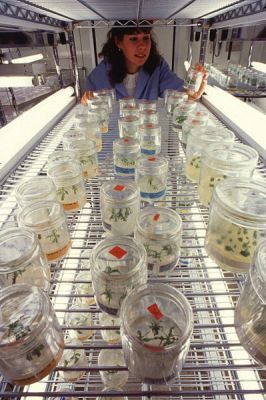
Technician Christine Berry checks on futuristic peach and apple “orchards”. Each dish holds tiny experimental trees grown from lab-cultured cells to which researchers have given new genes. Credit: USDA Agricultural Research Service
Despite industry claims to the contrary, critics warn that the use of genetically engineered (GE) trees would increase deforestation. The approvals could also spark off a new era of such products, which wouldn’t be confined solely to these countries.
“If Brazil and the United States get permission to commercialise these trees, there is nothing to say that they wouldn’t just export these products to other countries to grow,” Anne Petermann, the executive director of the Global Justice Ecology Project (GJEP) and the coordinator of the Campaign to Stop GE Trees, a network that Wednesday announced a new global initiative, told IPS.
“These GE trees would grow faster and be more economically valuable, so it’s easy to see how current conventional plantations would be converted to GE plantations – in many parts of Africa, Latin America and Asia. Further, both Europe and the U.S. are currently looking at other genetically engineered trees that bring with them a whole additional range of potential impacts.”
While the United States has thus far approved the use of two genetically modified fruit trees, the eucalyptus is the first GE forest tree to near release. Similar policy discussions are currently taking place in the European Union, Australia and elsewhere, while China has already approved and is using multiple GE trees.
 ConspiracyAnalyst.org