

American Greatness
By Roger Kimball
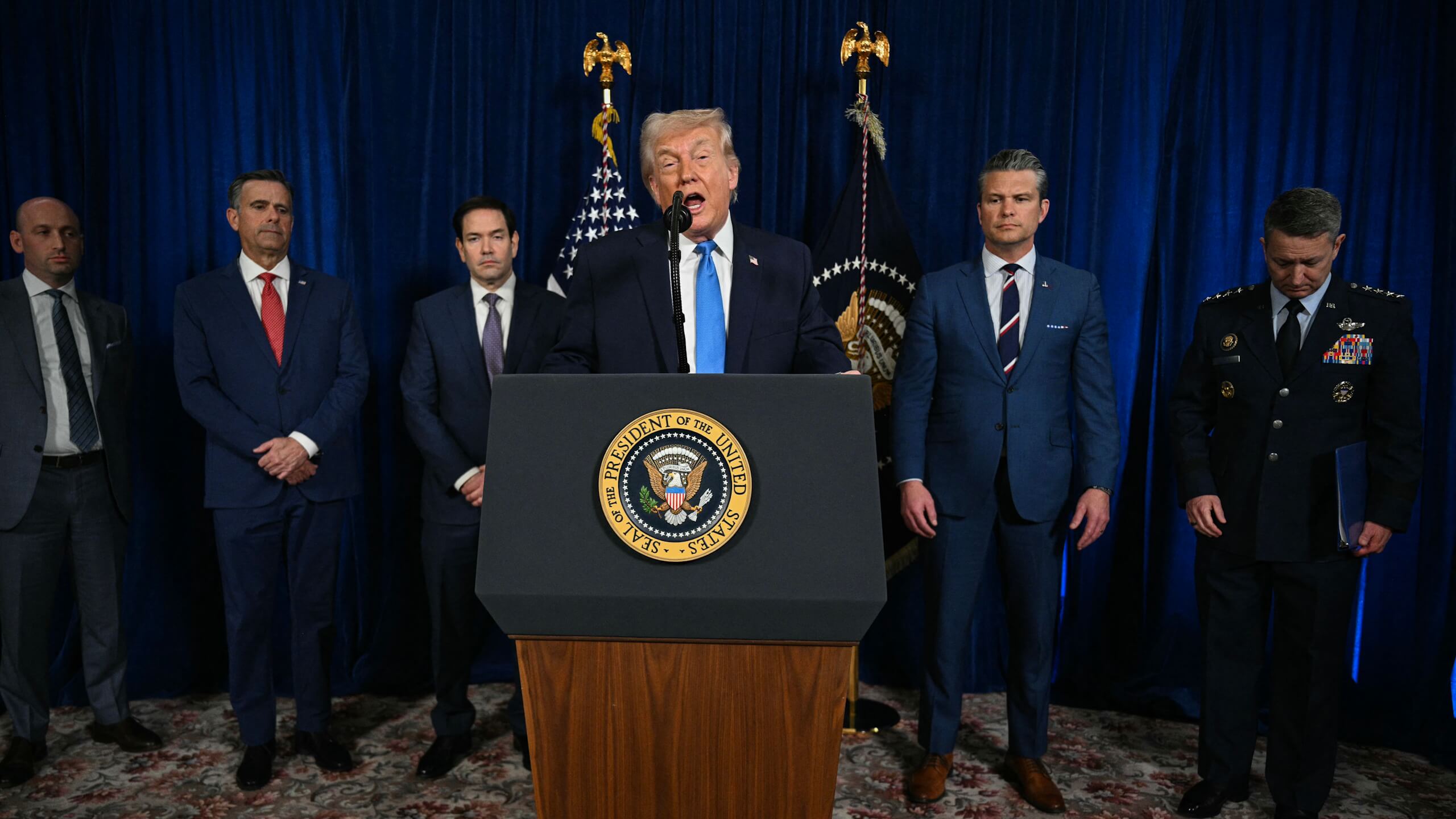
Trump’s lightning seizure of Maduro was not recklessness but doctrine in action: the Monroe Doctrine revived, enforced, and demonstrated—decisively—on the ground.
To understand the extraordinary operation conducted by the U.S. military and law enforcement over the night of January 2-3—an operation that extracted the Venezuelan dictator Nicolás Maduro and his wife, Cilia Flores, from the presidential palace and whisked them to the USS Iwo Jima bobbing off the coast of Caracas for extradition to the United States—the first thing you should read is the National Security Strategy released by the White House last month.
Among other things, this closely reasoned, 29-page document articulates an updated commitment to the Monroe Doctrine, named for the country’s fourth president, James Monroe, who first articulated the policy in 1823. In brief, the Monroe Doctrine held that the United States would look on foreign involvement in the Western Hemisphere as a direct challenge to America’s national interest. The National Security Strategy reaffirmed and extended America’s commitment to the Monroe Doctrine:
After years of neglect, the United States will reassert and enforce the Monroe Doctrine to restore American preeminence in the Western Hemisphere, and to protect our homeland and our access to key geographies throughout the region. We will deny non-Hemispheric competitors the ability to position forces or other threatening capabilities, or to own or control strategically vital assets, in our Hemisphere. This “Trump Corollary” to the Monroe Doctrine is a common-sense and potent restoration of American power and priorities, consistent with American security interests.
The world just witnessed what the application of the Trump Corollary of the Monroe Doctrine—what Trump himself referred to as the “Donroe Doctrine”—looks like “on the ground” when the Army’s Delta Force and Night Stalkers, supported by more than 150 manned and unmanned aircraft, mounted their astonishing assault. Trump announced the operation in a post on Truth Social at 4:21 a.m. on Saturday. Attorney General Pam Bondi followed up with a post introducing the legal context.
Nicolás Maduro and his wife, Cilia Flores, have been indicted in the Southern District of New York. Nicolás Maduro has been charged with Narco-Terrorism Conspiracy, Cocaine Importation Conspiracy, Possession of Machine guns and Destructive Devices, and Conspiracy to Possess Machine guns and Destructive Devices against the United States. They will soon face the full wrath of American justice on American soil in American courts.
She later released the indictment prepared by the U.S. Attorney Jay Clayton. (This 25-page document supersedes a 2020 indictment against Maduro.)
Naturally, the New York Times and other irrelevant honkers in the media reacted with stunned outrage. “Trump’s Attack on Venezuela Is Illegal and Unwise,” thundered a fraught column by the Editorial Board of the Times. (In case you did not know, the editorial board of the Times is “a group of opinion journalists whose views are informed by expertise, research, debate, and certain longstanding values.” I hope you are impressed.) “Mr. Trump,” these repositories of expertise clucked, “has not yet offered a coherent explanation for his actions in Venezuela. He is pushing our country toward an international crisis without valid reasons. If Mr. Trump wants to argue otherwise, the Constitution spells out what he must do: go to Congress. Without congressional approval, his actions violate U.S. law.”
In fact, President Trump offered an eminently coherent explanation for his action, both in his first post and then in the press conference he held on Saturday, in which he, Secretary of Defense Pete Hegseth, Chairman of the Joint Chiefs of Staff Dan Caine, and Secretary of State Marco Rubio described the operation and answered questions from the press. As for Congressional Authorization for the Use of Military Force, well, Ronald Reagan invaded Grenada in 1983 without Congressional authorization, and George H. W. Bush invaded Panama to nab the strongman and drug trafficker Manuel Noriega at the end of 1989-1990, also without an AUMF. (Coincidentally, the U.S. got Noriega on the same day we got Maduro, January 3.)
Beyond such precedents, President Trump made the important point that, given the secrecy and logistical complexity that the operation required, he could not practically have consulted with Congress without jeopardizing the mission. Moreover, he added, Congress had a habit of leaking, something else that would have threatened lives and the success of the operation.
In his remarks, Secretary Rubio reminded the press that that Maduro’s 2024 election was widely seen as illegitimate. Even Joe Biden’s State Department condemned the election as fraudulent. So did the Carter Center. So did many countries around the world. The true winner of that election was Edmundo González Urrutia.
The New York Times and kindred organs are consumed with rage at President Trump’s action in Venezuela. Already the left is fielding “free Maduro” protests. Anti-Trump libertarians like Thomas Massie and Marjorie Taylor Greene are crying in their milk. For their part, the Venezuelans themselves are delighted that the dictator who had oppressed them for so many years is gone. The internet—though not those portions policed by the left—is full of jubilant scenes of celebration. One of my favorites showed a huge image of Maduro being removed from a billboard as the crowd cheered.
This weekend’s precision strike, though amazingly successful—we lost not a single American life or aircraft—is not the end of the story. A corrupt dictator who terrorized and impoverished his people, exported murderers and drug dealers to the United States, and made Venezuela a haven for anti-American interests from China, Russia, Iran, and even Hamas, has been taken off the chessboard. But the country he left behind is a festering ruin.
Venezuela sits atop the world’s largest known oil reserves as well as huge reserves of gas, gold, and other mineral wealth. The United States essentially built its oil industry, which was expropriated by Maduro’s predecessor, Hugo Chavez. Earlier in the day that he and his wife were seized, Maduro entertained a special envoy from China, which has a strong interest not only in Venezuela’s oil but also in its potential as a destabilizing force in the Western Hemisphere. That project has been tabled.
In the coming months, President Trump explained in his press conference on Saturday, the United States is going to step in, help rebuild the country’s infrastructure, and put the country back on the road to prosperity and free government. There is talk of Edmundo González returning from his exile in Spain. Who will run Venezuela in the meantime? In two words, we will. Is this a return of the neocon practice of “nation building” and exporting democracy? No. Rather, it is an instance of that newly revitalized Monroe (or “Donroe”) doctrine that Trump’s National Security Strategy laid out. President Trump’s watchword is common sense. Common sense dictates that we not allow Venezuela to become a springboard for entities hostile to the United States. Therefore, we won’t.
 ConspiracyAnalyst.org